Showing posts with label Finances. Show all posts

Monday, December 10, 2012

United States of Moochers: Red vs Blue states

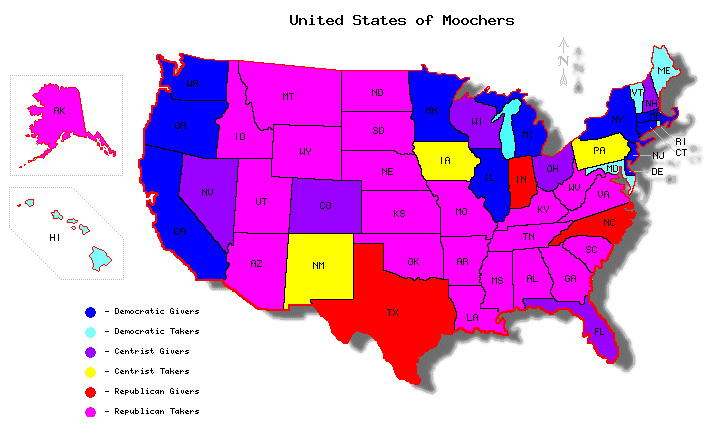
It's been a long campaign season, so I'm sure the first thing everyone wants to see is some extensive, in-depth political research! Some of you might remember an interesting figure that went around the internet a few years back. It sorts all US states into two columns, net contributors to the federal government vs. net takers; and two colors, red for republican and blue for democrat states. The conclusion is stark: republican states take more than they give to the federal budget, and democratic states give more than they take. But I thought the binary decision for each state (red or blue, giver or taker) was a bit simplistic, and it seems like it used just one snapshot of America (2004), so I did my own research. I gathered as much data as I could on the subject (sources were Wikipedia and the TaxFoundation.org). First, the normalized vote margins in the last 5 presidential elections (separated into colors at margin values of +/- 4% and +/-15%). Then the amount of money the federal government spends on each state, divided by the amount that state contributes, for the years 1981-2005, to get our "Mooching Factor".
Let red states secede if they want - that would solve our budget deficit instantly!
These results are also shown on this US map, where "Giver" states are given their normal red, blue, or purple, while the "Moocher" states are assigned the less-dignified colors of pink, cyan, and yellow.
You can clearly see that only 3/25 red states are givers (12%), while 11/16 blue states are givers (69%).  In fact, seven red states are bigger moochers than the worst blue state. But they say correlation (in this case 0.2, which is pretty weak) does not indicate causation. My first thought is that relative poverty rates in each state will be a determining factor. A state with richer people contributes more in taxes but takes less for social programs, right?
This explains part of the overall trend: red states tend to have higher poverty rates than blue states, so naturally they would be taking more money for social benefits while contributing less from taxes. But we see that all 10/10 (a shameful 100%) of "rich" red states still take more than they give, while only 4/13 (17%) of "rich" blue states do. Depressingly, poverty is less an indicator of whether a state is a giver or taker (0.12 correlation) than political lean (0.20). In the background you can see an aggregated "Redland" and "Blueland" (I didn't worry about "Purpleland"). We see that red states are significantly more impoverished, even though they have been receiving a "stimulus package" from blue states for at least 30 years running. But also interesting are the trends within Redland, where poorer red states don't necessarily take more than richer red states (the same is true for Blueland). It really looks like red states, not poor states, are inherently takers.

Another hypothesis is that each representative for a state is like a pig at the Federal Trough, grabbing as much money for their constituents as every other pig. That means that less-populous states, which have the same number of senators as big states, will have more congressional influence per capita, and therefore more federal money. I define "congressional influence" as the fraction of the House of Representatives that a state controls plus the fraction of the Senate that each state controls (this assumes both chambers of Congress are equal in budgetary power). In the plot below you can compare a state's congressional influence to its population by comparing the areas of the outer and inner circle; we see that for example, citizens of Wyoming have more than 10 times the congressional influence per capita as citizens of California.
It's evident that congressional influence is a large factor. Notably, each of the five most underrepresented states, regardless of political lean, all give more than they contribute. Over-represented red states are more likely to take more (all 18/18), while over-represented blue states are split evenly between givers and takers (5/10). This plot is perhaps the most damning of all for Republicans: it suggests that the only reason that any red states contribute more than they take is just because they don't have the congressional influence to grab more money from the Federal Trough, while blue states exercise fiscal restraint, even when they have the congressional influence to grab more money. Again, the implications are clear: Republican politicians greedily rake in as much money as they can for their states, while Democratic politicians govern toward some other goal, perhaps "the best interest of the country"? In the background of the figure we again see "Redland" and "Blueland", where Blueland has more people but less congressional influence, and therefore pays tribute every year to Redland. In fact, each citizen of Redland has 26.4% more congressional influence than a citizen of Blueland, which corresponds quite closely to their 26.4% higher Mooch Factor.

Red States Blue States
total moochers 88% (22/25) 31% (5/16)
fraction of poor states that are moochers86% (12/14)0% (0/2)
fraction of rich states that are moochers100% (10/10)31% (4/13)
fraction of under-represented states that are moochers 57% (4/7) 0% (0/6)
fraction of over-represented states that are moochers 100% (18/18) 50% (5/10)
Federal money spent/contributed ("Mooch Factor") 1.16 0.91
poverty rate 14.3% 11.7%
US population fraction 39% 41%
fraction of congress ("congressional influence") 44% 37%

Aren't Republicans supposed to be fiscally-responsible small-government advocates? If blue states are taking less but still have lower poverty for 30 years now, perhaps their governing model is more successful: social services to people in need, rather than trickle-down Reaganomics for the wealthy.

Thursday, August 16, 2012

Too lazy to "Occupy"? Hit the ATM.


When the "Occupy" movement first started, I felt like there were some legitimate claims buried in somewhat incoherent message. To me, the most compelling complaint is related to the increasing separation of wealth, how "the rich get richer". For example, since Reagan took office, the increase in after-tax income has leapt significantly for the richest Americans (much of which can be explained by Reagan slashing taxes for the richest Americans), while rising only modestly for the bottom 80%.


Increase in After-Tax Income by Income Group 1979-2007
Source: Congressional Budget Office

What is causing this increasing separation of wealth? Why are the rich getting way, way richer, while everyone else is making only modest gains? Well that growth in the top 1% starting from 2002, which as you can see is not reflected among the poorer 99%, corresponds roughly with the Bush Tax Cuts for the wealthy. It just seems like a shameful state of affairs when companies consider the "Return On Investment" for lobbyists and campaign contributions. The wealthy spend some of their money on influencing politicians, who devise laws that benefit the wealthy at the expense of everyone else. Everybody wins!

But I didn't really want to talk politics too much today. I guess it's just the little things that bother me. The banks offer you and me 1% cash back for using their credit cards, but they charge the vendor 3%, which the vendor turns around and charges us, through increased prices, even for those of us who use cash. In fact it's against the law to charge a higher price for consumers who use credit cards; guess who wrote that law? So we're stuck in a cycle where the banks make 3% on every transaction, for doing almost nothing.

Now, when the Occupiers started Occupying, I figured "I have a job, I don't have time to stand around complaining all day." But now I can see one small way we can all support income equality, without quitting our day jobs: visit the ATM. The bank earns nothing on cash transactions. When you use your credit card for $100, you are basically hiring the bank to walk over to the ATM, withdraw $100, and give it to the cashier, and you are paying $3 for this service. If instead we all visit the ATM once a week and pay most of our transactions in cash, we save that money, resulting in lowered prices for consumers and higher revenues for business which actually produce economic value. For a person making the median personal income in the USA, $32,000, who spends 30% of their income through their credit card, they are paying almost $300 per year to the banks.

If you want to combat the growing wealth disparity in the USA, and help ensure that less money is paid to companies that don't actually produce any economic value, hit the ATM once a week. 

Tuesday, March 2, 2010

Forrest's incompetent money advice

Welcome to the first installment of what I hope will be a long series of articles containing my incompetent advice, on many issues. Today the topic is money.

I won't cover the (much more important) issue of actually obtaining money in very much detail. Suffice it to say that there are many different ways to get it, and to spell them out would just be ... trivial. To list just a few examples: donation of haploid cells (if you happen to be a genetically fortunate male), having rich older relatives, and marrying "up". Or you could stick with the traditional "get a job" route, but that wouldn't be nearly as easy or fun as the aggregated average of my three examples.

Now that you have lots of money, what should you spend it on? If, like the majority of Americans your happiness is a linear correlation with your rate of spending, you should spend it all at once, and also max out your credit cards. If, however, you happiness production curve is more reasonable, there's an optimal amount of money you should spend in a typical week on frivolous things like ice cream, new clothes, or that kidney transplant you've been putting off.

As you can see, the more money you spend on nice things for yourself, the happier you get. But consider this example: You could spend $1000 on a small, shoddy-looking, used motorcycle and have some fun riding around and running errands, or you could spend $10,000 on a shiny new motorcycle and have a bit more fun impressing your friends and bothering the neighbors with your engine noise. On the other hand, you could spend $2 on bus fare, have to get up early every day, and miss the bus sometimes. Your choice depends on how much you would enjoy each thing, and also on how much money you had in the bank. Except for explaining what's going on, I can't offer any extra help on what to spend your money on. As my most loyal readers will note, I spend most of my money on bacon.

No, the topic that interests me today is what to do with money you're saving. Where should you keep it? The first option is in the bank. For many people, keeping the majority of your money in the bank is the smart thing to do. The bank will never lose your money (or if they do, Uncle Sam will cover it). You'll never* lose money at the bank. (* some restrictions and fees apply to low balances, too many transactions, using other banks' ATMs, or trying to access your money). Banks will even give you a small amount of interest, as a reward! Note, however, that this interest rate is generally not much better than the rate of inflation, and often (like right now) much lower. What this means is that yes, you won't lose money if you keep it in the bank, but you will lose value. You'll be able to buy fewer motorcycles with that money when you withdraw it in 5 years than you could have today. The moral here is that banks don't really keep your money "safe".

The next option is to keep all your money at home. You could either keep it as cash, which would be like a bank only without the fees, interest, and inconvenience. Or you could keep it as a commodity, like gold. Gold (in theory) is not subject to inflation. No more gold is ever created (yes, I know more gold is mined, but ignore that for a second). You can buy the same number of motorcycles in five years with the same lump of gold (or, like me, a small fraction of a motorcycle). However, you keeping stuff in your house isn't safe against robbery, and gold is inconvenient to change into cash.

The third option is to invest your money. The word "invest" branches into a lot of other things, but the underlying principles are the same for each type: you essentially gamble your money, hoping the value of your investments will rise. With higher risk comes higher reward: you know for sure that in the bank, your money will be worth almost as much as it is now, when you withdraw it in five years. With an investment, you run the risk of losing value, but that earns you the possibility of gaining value. Now different investments are in different places on the "risk - reward" spectrum.

As you can see from this image I pulled straight from wikipedia, with higher risk comes higher reward. The light blue line represents possible investment choices, and the dark blue line, which is unique to each individual, represents a line of constant "utility", which pretty much means "happiness". Some people are young and OK with more risks, so their dark blue line shifts up-right. Others might be planning to buy a house soon, and have the right amount of money, so they don't want to lose that money. Their dark blue line shifts down-left. Yet other people might want to help save humanity by investing in green energy or something, which would change their "happiness" curve in various ways.

Diversification: Buying stocks can give you a good return, but there is a way to lower the amount of risk without compromising the amount of return: Diversification (that's right, Diversification). Let's say you buy $100 worth of google. Google's stock will roughly follow that of all stocks in its main area, like microsoft and apple. But sometimes when google does poorly, apple does well. If you buy a collection of several stocks from that sector, like microsoft, apple, and google, then the value won't jump around as much, but it will still rise when the sector rises. But you can take this one step further and say "when tech stocks fall, sunblock stocks will rise!" (because all those WoWers and googlers have pale, pale skin) and also buy some shares in the sun-block sector. Taking it even further, you might note that when stocks do poorly, bonds do well, so you could buy some of those.

In fact, a while ago some people had the great idea to put all their money together and hire someone to decide what to invest it all in (so they didn't have to quit their jobs and watch the stock market all day). That's called a mutual fund. Various other types of investments exist, filling niches of the risk-reward spectrum and offering different amounts of diversification.