Showing posts with label Politics. Show all posts

Friday, July 17, 2015

New Hampshire in presidential politics

Measurements of smaller populations should have larger uncertainty and error bars - and this is exactly what we see in New Hampshire, the smallest state to be covered so far on this blog series. Aside from a spectacular win by George H. W. Bush in 1988, New Hampshire has fluttered back and forth from republican-leaning in 1992 to democratic-leaning in 1996, back to the right in 2000, and finally back to the left for the following 3 elections since. I'll interpret this to mean that the Dukakis campaign probably abandoned all hope of winning there, and focused instead on other states. Subsequent campaigns probably focused more on New Hampshire, bringing it closer to the center.

We can see the somewhat ridiculous prediction by my naive linear model: an 8.9% advantage by the democrat, with rather large 4.6% error bars. Any real person looking at this data would predict that it'll probably be much closer, with perhaps a small democratic advantage (neglecting 1988 from my linear fit model - without any objective basis - gives a prediction of a smaller democratic advantage of 0.8-5.4%). My model could benefit from some way of weighting recent elections more heavily than long-ago elections. Maybe next time.

Coming up sometime soon (maybe) by popular demand: including the midterm election data in my prediction and analysis!

Thursday, July 16, 2015

Arizona in Presidential Politics

Good old Arizona. I've seen a fair bit of interest on the left in a demographic advantage that Democrats my someday gain in Arizona (and other states, mostly in the South). So when I analyzed Arizona's margins in the last 7 elections, I was expecting to find some interesting wiggles and bounces. I was disappointed.


Aside from a small bounce for Republicans in 2008 (caused by hometown hero John McCain at the top of the ticket), Arizona has had little movement over the past 7 elections. In constructing my simple linear model, I excluded the 2008 data, and got a prediction that in 2016, Arizona will vote about 10% more republican than the nation as a whole. As it always has.

Blatantly screen-grabbing another website that lets me easily make my own little predicted map of the 2016 election, here's what we've got so far:

In this map I've shaded the states red or blue based on my guess as to whether or not a given party has a large advantage in that state. In other words, democrats won't necessarily win Pennsylvania, but if they've lost Pennsylvania, it will be because they've done very poorly in the national popular vote. As I visit each state on this blog, I'll fill in more states on this map, or leave them blank if they're true toss-up states. But as of right now, Democrats seem to be sitting pretty.

Astute readers will note that I have declared certain states without presenting a detailed analysis. For some of those states, I'll visit them in forthcoming posts. For others, I'll just let the history speak for itself (and if you want to gamble that Wyoming breaks blue, I'll take that bet).

Wednesday, July 15, 2015

Missouri: A Bellwether state from yesteryear

Until 2008, Missouri had the longest unbroken streak of electing the presidential candidate who ended up winning the presidency (although not always the popular vote). But during the last two cycles, Missouri abandoned its bellwether status, breaking toward the republicans even when Barack Obama won the national popular vote by more than seven points.

Starting in 1996, Missouri started drifting to the right of the nation as a whole, culminating in a 10% romp for Romney in 2012 while the nation voted for Obama by 4%. Based on my simple linear model, Missouri is almost certain to break for Republicans by a large margin.

Tuesday, July 14, 2015

Nevada in presidential politics

The next stop for our tour of possible swing states is Nevada.

We can see a pretty clear case of a state that has shifted somewhat from flirting with the republican party to flirting with the democratic party. Based on my extremely simple model, if this trend continues, Nevada has an 84% chance of voting at least 4.8% more democratic than the nation as a whole.

What might be causing this slow-and-steady shift to the left for Nevada? Perhaps an influx of minorities and young workers.

Monday, July 13, 2015

Kansas in Presidential Politics

Just a quick post that looks like all the others. Here I focus on Kansas, and how it has shifted from 5% more republican than the rest of the country, to reliably 25%+ more republican than the U.S. as a whole.
In contrast to the previous two states I've analyzed, Kansas clearly and definitively departed the "swing state" zone a long time ago. It's probable that neither party bothered to mount much of a campaign, causing Kansas to quickly shift to some kind of "natural state", the way it votes for president when it isn't a focus for both campaigns. And for Kansas, that natural state seems to be solid red.

Thursday, July 9, 2015

Pennsylvania in presidential politics

This is the next post in our series, "How are the swing states doing anyway?" Next up, we have Pennsylvania, which has been consistently just a little more democratic than the nation as a whole:

It has jumped around a little bit, so it's hard to discern any real trend other than "probably steady". Quantitatively this translates into our 2016 prediction: Pennsylvania will probably be around 2.6% more democratic than the rest of the nation (68% chance for a democratic advantage between 1.15-4.05%, with large assumptions including a straight-line fit through the historic dem advantage).

Without a clear trend, I won't even try to come up with any kind of guess about what demographic, political, or economic events could have been causing these observed numbers.

Once I complete this kind of analysis for all of the swingier states, I'll be able to construct a model predicting which states are likely to be the tipping point states, and what kind of national vote totals will translate into an electoral college win on either side.

Monday, July 6, 2015

Virginia in presidential politics

I love projecting presidential elections way too early, so obviously it's time to start predicting for the 2016 Big Game!

Today, I wanted to talk specifically about Virginia. Until recently, Virginia has been considered "safely" Republican during the presidential election - even if you count 2008, when Barack Obama won the state. What do I mean?

Let's go back to 2008, when Barack Obama won Virginia by a 6.3% margin, while winning the US popular vote as a whole by 7.3%. Now let's say we adjust our magical "popular vote" dial, reducing the democrat's share of the popular vote equally among all the states. The first state to flip to the republicans would be North Carolina. Then Indiana, Florida, Ohio, and then Virginia, at which point John McCain would still have been 11 electoral votes shy of winning. On top of all those states, he would also have needed to flip Colorado and finally Iowa, which would have been unlikely if he hadn't ALREADY won Virginia. So, for Obama, Virginia was unnecessary to his win, and for McCain, winning Virginia would be a given if he had carried Colorado and Iowa, which would have been required to win the election. Let's use Nate Silver's terminology and designate Iowa the "Tipping Point State" for 2008. Under that model, either candidate just has to win Iowa and all the states on their side of Iowa, assuming each state has a reasonably similar per-capita elasticity (voter response to campaign activity) and each campaign has pretty good knowledge of current polling in each state. How will each state change with respect to the national average? Let's zoom in on Virginia:


In the graph above I've plotted Virginia's Democratic (2-party share) vote margin for the past seven presidential elections. Although the national and statewide margins bounce around chaotically, by looking at the difference ("how republican Virginia is compared to the nation as a whole"), we can see that Virginia has slowly but clearly been drifting away from Republicans since 1988, culminating (so far) in the 2012 election, when it had essentially the same vote margin as the nation as a whole. Based on a simple linear fit, I predict that in 2016, the democrat will get a higher margin in Virginia than nationwide, by about 2%, for the first time since FDR. That means that even if the Republican gets 51.00% of the national popular vote, they'd still lose Virginia.

[Update: the error bars show +/- one standard deviation from the linear model. In other words, if all my assumptions are true, there is a 68% chance that Virginia in 2016 will fall between the two error bars, and be somewhere between 0.8% and 3.3% more democratic than the country as a whole.]

I'm sure there are numerous expensive demographic studies out there detailing exactly why Virginia is drifting from right to center ... so does anyone want to trudge through them for me? My guesses at the moment:
1) growth in the DC suburbs and exburbs,
2) more generally, increasing urbanization throughout the state, and
3) a growing young and minority population, which is disproportionately happening in Virginia.

I hope to complete a similar analysis for all of the so-called "battleground" states, and calculate a prediction of the systematic advantage the democrat or republican has going into the election. I'd be so excited if the democrat won the electoral college but lost the popular vote; then we might finally see some bipartisan reform to the current broken electoral college system!

Monday, December 10, 2012

United States of Moochers: Red vs Blue states

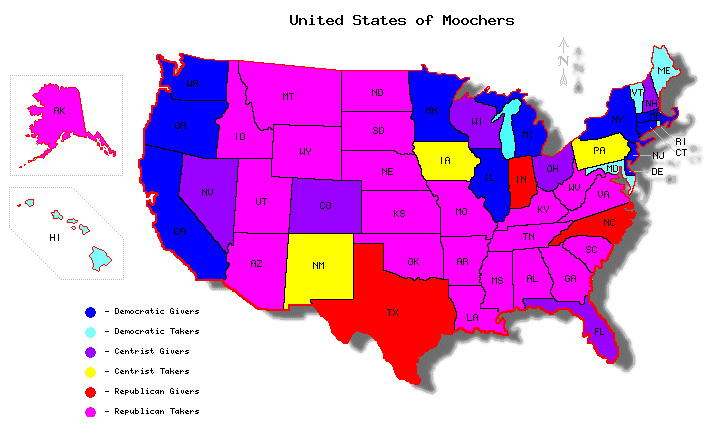
It's been a long campaign season, so I'm sure the first thing everyone wants to see is some extensive, in-depth political research! Some of you might remember an interesting figure that went around the internet a few years back. It sorts all US states into two columns, net contributors to the federal government vs. net takers; and two colors, red for republican and blue for democrat states. The conclusion is stark: republican states take more than they give to the federal budget, and democratic states give more than they take. But I thought the binary decision for each state (red or blue, giver or taker) was a bit simplistic, and it seems like it used just one snapshot of America (2004), so I did my own research. I gathered as much data as I could on the subject (sources were Wikipedia and the TaxFoundation.org). First, the normalized vote margins in the last 5 presidential elections (separated into colors at margin values of +/- 4% and +/-15%). Then the amount of money the federal government spends on each state, divided by the amount that state contributes, for the years 1981-2005, to get our "Mooching Factor".
Let red states secede if they want - that would solve our budget deficit instantly!
These results are also shown on this US map, where "Giver" states are given their normal red, blue, or purple, while the "Moocher" states are assigned the less-dignified colors of pink, cyan, and yellow.
You can clearly see that only 3/25 red states are givers (12%), while 11/16 blue states are givers (69%).  In fact, seven red states are bigger moochers than the worst blue state. But they say correlation (in this case 0.2, which is pretty weak) does not indicate causation. My first thought is that relative poverty rates in each state will be a determining factor. A state with richer people contributes more in taxes but takes less for social programs, right?
This explains part of the overall trend: red states tend to have higher poverty rates than blue states, so naturally they would be taking more money for social benefits while contributing less from taxes. But we see that all 10/10 (a shameful 100%) of "rich" red states still take more than they give, while only 4/13 (17%) of "rich" blue states do. Depressingly, poverty is less an indicator of whether a state is a giver or taker (0.12 correlation) than political lean (0.20). In the background you can see an aggregated "Redland" and "Blueland" (I didn't worry about "Purpleland"). We see that red states are significantly more impoverished, even though they have been receiving a "stimulus package" from blue states for at least 30 years running. But also interesting are the trends within Redland, where poorer red states don't necessarily take more than richer red states (the same is true for Blueland). It really looks like red states, not poor states, are inherently takers.

Another hypothesis is that each representative for a state is like a pig at the Federal Trough, grabbing as much money for their constituents as every other pig. That means that less-populous states, which have the same number of senators as big states, will have more congressional influence per capita, and therefore more federal money. I define "congressional influence" as the fraction of the House of Representatives that a state controls plus the fraction of the Senate that each state controls (this assumes both chambers of Congress are equal in budgetary power). In the plot below you can compare a state's congressional influence to its population by comparing the areas of the outer and inner circle; we see that for example, citizens of Wyoming have more than 10 times the congressional influence per capita as citizens of California.
It's evident that congressional influence is a large factor. Notably, each of the five most underrepresented states, regardless of political lean, all give more than they contribute. Over-represented red states are more likely to take more (all 18/18), while over-represented blue states are split evenly between givers and takers (5/10). This plot is perhaps the most damning of all for Republicans: it suggests that the only reason that any red states contribute more than they take is just because they don't have the congressional influence to grab more money from the Federal Trough, while blue states exercise fiscal restraint, even when they have the congressional influence to grab more money. Again, the implications are clear: Republican politicians greedily rake in as much money as they can for their states, while Democratic politicians govern toward some other goal, perhaps "the best interest of the country"? In the background of the figure we again see "Redland" and "Blueland", where Blueland has more people but less congressional influence, and therefore pays tribute every year to Redland. In fact, each citizen of Redland has 26.4% more congressional influence than a citizen of Blueland, which corresponds quite closely to their 26.4% higher Mooch Factor.

Red States Blue States
total moochers 88% (22/25) 31% (5/16)
fraction of poor states that are moochers86% (12/14)0% (0/2)
fraction of rich states that are moochers100% (10/10)31% (4/13)
fraction of under-represented states that are moochers 57% (4/7) 0% (0/6)
fraction of over-represented states that are moochers 100% (18/18) 50% (5/10)
Federal money spent/contributed ("Mooch Factor") 1.16 0.91
poverty rate 14.3% 11.7%
US population fraction 39% 41%
fraction of congress ("congressional influence") 44% 37%

Aren't Republicans supposed to be fiscally-responsible small-government advocates? If blue states are taking less but still have lower poverty for 30 years now, perhaps their governing model is more successful: social services to people in need, rather than trickle-down Reaganomics for the wealthy.