1)Starting with ancient cultures, we have known or speculated that we live on a sphere ("Earth") nearby some other objects (the sun and planets), which are all surrounded by little twinkly lights (other stars). Assigning a date and person to this discovery is tricky, but a good guess is an African named Eratosthenes in Egypt, who measured the earth's diameter in ~200 BCE. He did this by noting that on the summer solstice, the sun shone exactly straight down in one city, but cast a shadow about 1/50th of a circle in another city. He knew the difference in the distance between the two cities, and using "math" he calculated the diameter of the earth. So the size of the known universe, in our understanding, was the earth's diameter: 12,800 km.
2)It wasn't until Johann Kepler in the 1600s that we were relatively confident that our Earth was not fixed, but was moving around the sun (and not the other way around). This had been hypothesized before, but only at that time had it been proven and accepted. This increased the size of the known universe to the diameter of the major axis of Saturn's orbit (then the furthest known planet): 1.4 billion km.
3)Even then, it wasn't until Frederich Bessel in 1838 that we confirmed that the other points of light in our sky are stars similar to our sun, and found the distances between them. He did this by measuring the angle of a "nearby" star against the background, further away stars as the earth moved in its orbit. Just like the two images from our eyes allow us to tell the distance to something, this parallax allowed us to calculate the distance to the stars. Until then the working theory was that they were unknown lights, possibly infinitely far away. Now the size of the known universe became the size of our galaxy: 950 million billion km.
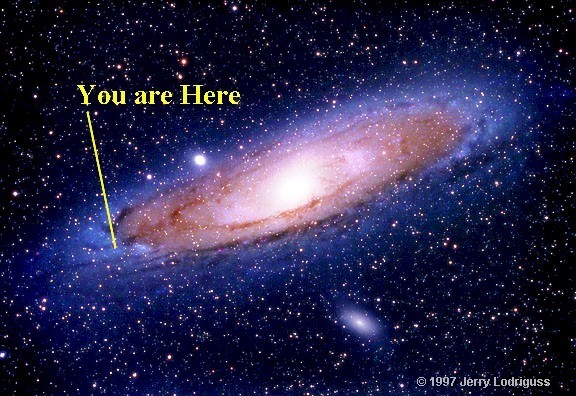 4)Only in the twentieth century did we realize that our galaxy was not the entire universe, but merely one tiny, tiny piece of it. Edwin Hubble helped us realize this when he observed objects receding away from us much more quickly than the escape velocity of our galaxy, and this was later confirmed by measuring the brightness of certain standard objects (e.g. Cepheid Variables or Type 1a Supernovas) within those galaxies. This inflated our known universe to the distance between these "nearby" galaxies, about 60 billion billion km.
4)Only in the twentieth century did we realize that our galaxy was not the entire universe, but merely one tiny, tiny piece of it. Edwin Hubble helped us realize this when he observed objects receding away from us much more quickly than the escape velocity of our galaxy, and this was later confirmed by measuring the brightness of certain standard objects (e.g. Cepheid Variables or Type 1a Supernovas) within those galaxies. This inflated our known universe to the distance between these "nearby" galaxies, about 60 billion billion km.5) At about the same time, we discovered that the universe is expanding. Our perception of the size of the universe expanded with it, until in the 1960s we found the observational limit: a distance so far that the light has travelled for about 13-14 billion years. Wikipedia explains this barrier nicely:
In practice, we can see light only from as far back as the time of photon decoupling in the recombination epoch, which is when particles were first able to emit photons that were not quickly re-absorbed by other particles, before which the Universe was filled with a plasma opaque to photons. The collection of points in space at just the right distance so that photons emitted at the time of photon decoupling would be reaching us today form the surface of last scattering, and the photons emitted at the surface of last scattering are the ones we detect today as the cosmic microwave background radiation (CMBR).
Now, you might think that that means the limit of our observable universe is a sphere of diameter 13 billion light-years. However, because space itself has expanded during that time, the objects we are observing from 13 billion years ago are now much farther away, meaning the diameter of the observable universe is almost one million billion billion km.
5) And only very recently (1998) have we realized that the expansion of the universe is accelerating, a prediction which completely alters our view of the universe's fate. Current cosmological thinking has no estimate for the boundary of the universe. Our observable universe might be a tiny bubble in an infinite volume; the new estimate is literally "infinity until further notice".
Each of these five discoveries monumentally changed our understanding of the universe. Each time, the universe becomes monstrously larger than we had previously thought, and all of our assumptions become completely challenged. I have taken the liberty of tabulating the size of the "known universe" along with the date, for demonstration purposes:
| date | size of known universe (km) | note |
| 200 BCE | 12,800 | diameter of the earth |
| 1600 | 1,400,000,000 | size of our solar system |
| 1838 | 950,000,000,000,000,000 | diameter of our galaxy |
| 1924 | 60,000,000,000,000,000,000 | size of our "local group" of galaxies |
| 1960s | 1,000,000,000,000,000,000,000,000 | size of the observable universe |
| 1998 | "literally infinity" | astronomers give up |
I observe that the rate of this growth as a function of time is not governed by any reasonable function, but might be considered to be logarithmic starting in 1600, with our known universe expanding by a factor of 10 every 24 years until recently, when astronomers simply gave up. This rate of growth (in understanding) is, I'm sorry, astronomical.
There are still so many unresolved questions about the nature of our universe. So-called "dark matter" is required to explain why galaxies spin the way they do, and it has been detected indirectly, but we still have no idea about its nature. If it exists, there is postulated to be five times as much of it, whatever it is, than "regular" matter. Things become stranger: in order to explain the accelerating expansion of the universe, astronomers and cosmologists posit a "dark energy", an unknown force that would have to have 20 times as much "mass-energy" as observable mass in the universe. Mass-energy is the unit used because, as Einstein showed, energy can be converted into matter, or vice versa. If we converted all the dark energy into regular matter, there would be 20 times as much of it.
To butcher a quote by Socrates, "A wise man understands that he knows nothing." The more we study, the less we seem to understand. Maybe that's just the nature of the universe.


